
Have you ever thought about how you learned to pray? Was it sweet bedtime rhymes, a mealtime blessing, or hearing an adult praying out loud?
When our boys were little, they learned a couple of short, sweet prayers at church. Perhaps you or your children did too. Maybe you have even taught them to your grandkids. One went like this…
“God is good, God is great,
Let us thank Him for our food,
By His hands we all are fed,
Thank You God for our daily bread”.
Another one they said in unison as a class each week before snack was:
“Thank You, God, for the treats so sweet,
Thank You, God, for the food we eat,
Thank You, God, for the birds that sing,
Thank You, God, for everything”.
These words were precious coming from my three-year-old’s mouth. But when an almost seven-year-old was still saying them the exact same way, I couldn’t help but wonder: Have we missed the mark? Were we truly teaching how to pray and talk to God, or just how to recite poems?
I do not want children to just go through the motions. I wanted them to experience real conversations and genuine communion with God.
There is value in teaching our kids, even toddlers, to move beyond cute, memorized prayer poems and learn to pray original prayers—teaching them to have a conversation with God.
So how do we help our children learn to pray more authentically?
- Start with simple thanksgiving in their own words. With toddlers and preschoolers, a great first step is to invite them to name things they are thankful for. One day it might be mac and cheese; the next might be a favorite toy, or a friend at school. This is okay! If it is something they are thankful for and they thought of it, then it’s a real conversation, not just a recitation. We can gently guide them—“What’s one thing you want to thank God for today?”—and celebrate whatever they say as they learn to bring their hearts to God.
- Help them pray Scripture. We learn by example long before we realize we are learning. Teaching our kids or grandkids to talk to God is vital for a healthy spiritual relationship—and it shapes how they relate to others, too. In my kindergarten–third grade church group, we memorize the Model Prayer (Matthew 6:9–13). There is tremendous value in memorizing Scripture and hiding God’s Word in our hearts. But Jesus also warned against “heaping up empty phrases” (Matthew 6:7). Memorization and meditation are good; mindless repetition is not. We want children to learn to talk to God and keep their hearts close to Him, not to run through prayer time without truly paying attention. When we teach our kids to pray Scripture—turning verses into their own words—God’s Word begins to shape their thoughts, requests, and their view of who He is.
- Explain what verses mean as you pray them together. Kids ask the best questions when we actually pray with them instead of just reciting something. For example, 1 Thessalonians 5:16–18 says, “Rejoice always, pray without ceasing…” How can someone pray without ceasing? Explain that it does not mean to pray all day and all night. Instead, it means staying in an ongoing conversation with God. We can whisper short prayers before a test, or when scared of the dark, or when something good happens—then we are turning our thoughts to Him often. Then there is the part of “giving thanks in ALL circumstances”—This raises big questions, especially when a loved one dies, or the family dog gets hit by a car, and when other hard things happen. When we use Scripture, instead of quoting a poem-like prayer, kids may ask, “How do I thank God when I am sad?” These questions can mature their faith, letting them see we can be honest with God about our pain and still trust that He is good. John 14:14 is another verse kids like to latch onto—it says, “if you ask anything in my name, I will do it.” On its own, it sounds like a magic genie. But when we read the verses around it, we see Jesus was preparing His disciples to continue His ministry. Verse thirteen explains that our prayers should bring glory to the Father through the Son. It is about God’s purposes, not our wish list.
- Teach them to look at verses in context and learn together as a family. Kids are never too young to learn that we don’t build faith from one single verse. We need to read passages and look at the whole story. I can almost hear those little voices now: “I want a new pony for Christmas, in Jesus’ Name!” This is a great opportunity to open the Bible together and say, “Let’s see what Jesus was talking about here.” Show them how to look at more than one verse. Explain that God cares about our needs, and He wants to reshape our desires to match His will. If you feel like you don’t know the right answers, that is ok, learn together. Invest in a good study Bible or commentary to help you understand. Read a children’s Bible with your kids—you might be surprised how much it helps you as a growing believer. What matters most is that families keep growing together.
- Show them that real payer changes our desires. As we grow and mature in our faith and as we continue walking with Jesus, our desires begin to line up with God’s will. He knows our deepest thoughts and the intentions of our hearts. We can teach children to talk honestly with God about our lives, our fears, worries, joys, and successes—and trust Him with the outcome.
Two tools I use with kids are the A.C.T.S. Prayer Model and the Five Finger Prayer. They give simple structure while still leaving room for sincere, original prayers.
The A.C.T.S. Prayer Model has been a helpful guide for many believers. Each letter represents a different type of prayer:
- A—Adoration – Giving God the praise only HE is worthy of. Praise Him for all His majesty, love, holiness, faithfulness, and power (Psalm 63:3–4).
- C—Confession – Naturally pours out of us when we adore God and realize our unworthiness. We can never learn too early to start admitting when we do wrong and then asking for forgiveness. Encourage kids to name specific sins—things they have done, said, or thought that go against God’s Word (Psalm 51:10).
- T—Thankfulness – We all have reasons to be thankful. Help kids notice their everyday blessings and thank God for them. Find at least one thing to be thankful for every day (Psalm 100).
- S—Supplication – We need to teach kids to pray for the needs of others. Supplication is asking God to move on behalf of the needs of others and ourselves. We can pray for salvation, illness, wisdom, or God’s guidance (Philippians 4:6).
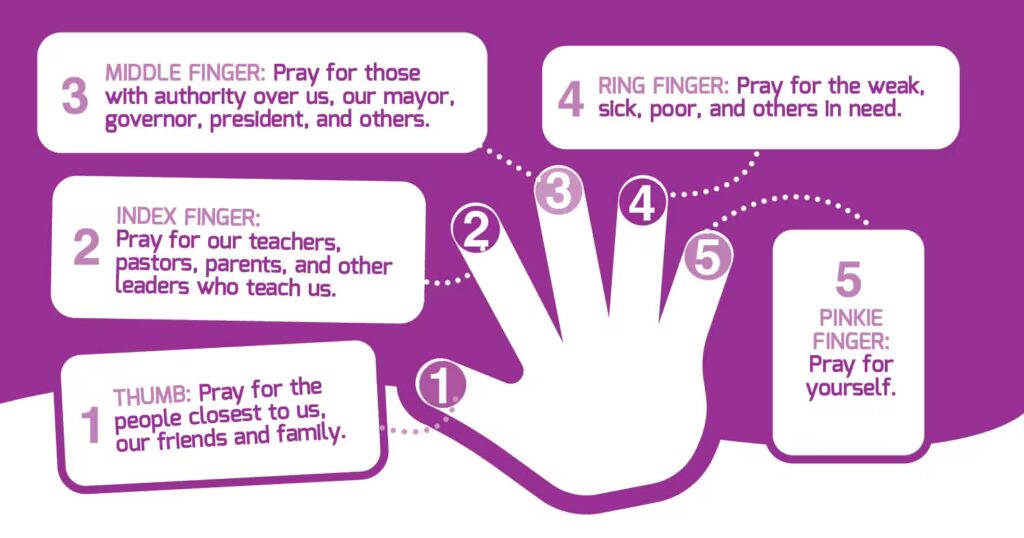
The Five Finger Prayer is another simple tool to help kids remember who to pray for. Each finger represents a different group of people. This model helps kids learn more about supplication. The thumb—pray for those closest to us (our family and friends). Index finger—pray for our teachers to help us learn Godly wisdom. Middle finger—pray for those in authority over us. Our government, police, army, and others who lead us. Ring finger—the weakest of all, pray for the sick, hurting, and others in need. Last, the pinky finger—we should pray for ourselves LAST, thinking of and praying for others first! These simple models help shift kids’ focus outward, away from a me, me, me mindset. Help your kids learn to have a heart for others.
A little glimpse of what God is doing.
This week in my 5–6 year old “Beginners Church,” I asked, “If you could ask God for anything, and He would give it to you, what would you ask for”? Their answers blessed me—one said she would ask for lots of money to buy food for hungry people. Another said she would ask for a giant house so that people without a home could come live with her. All of my class asked for something they could use to help others. No one asked for toys or things, even with Christmas approaching! We were learning about Solomon asking God for Wisdom, but my class understood the concept before I ever taught the lesson. When parents intentionally disciple their kids at home, we can see the results at church. These are the kinds of things we should hope all our kids pray about.
We need to be raising a generation that owns their faith.
Our children need more than memorized, rhyming prayers. Kids need adults to model sincere, Scripture-based conversations with God and invite them to have the same type of relationship. Let’s teach them to praise God for who He is, confess their sins, thank Him for blessings, pray for the needs of others, and pray for themselves. When we do, we are stepping closer to raising a generation of disciplemakers—kids who don’t lean upon the faith of their parents’ but truly own their personal walk with Jesus!
Get your copy of Walking With Jesus by Jennifer Barnett to continue in the discipleship and faith formation of your kids here.